.webp)
LC-MS Solvents
|
Liquid chromatography–mass spectrometry

Scharlau LC-MS Solvents
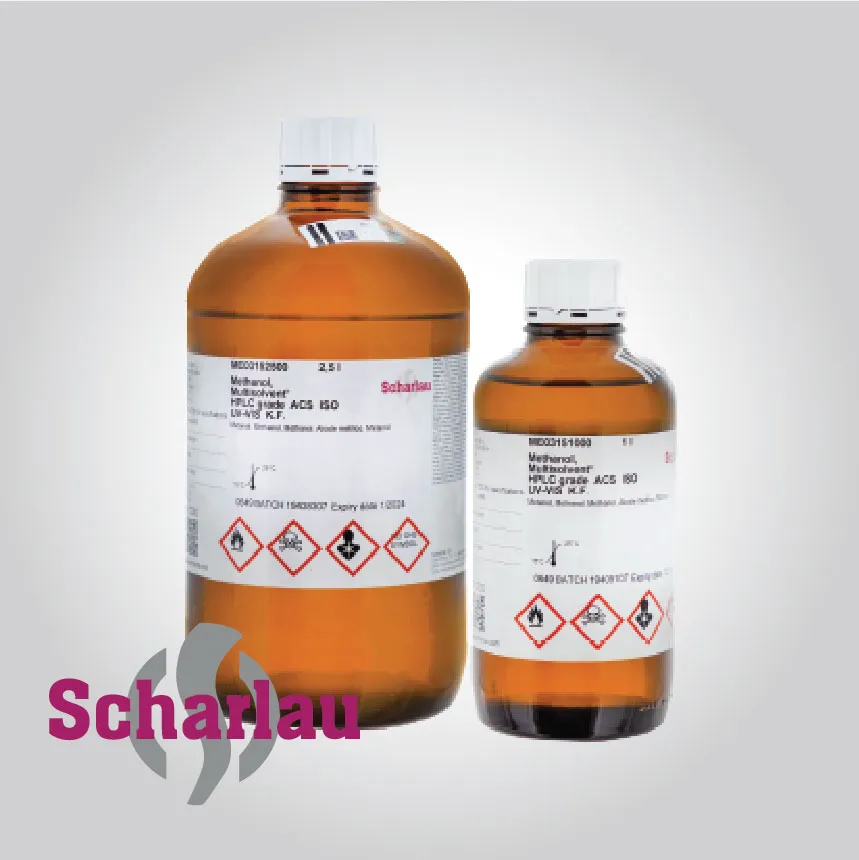
Scharlau LC-MS grade solvents are engineered to address the specific technical challenges of liquid chromatography coupled with mass spectrometry. Unlike standard HPLC reagents, LC-MS solvents must exhibit exceptionally low levels of inorganic and organic impurities that could lead to background noise or chemical interference. These solvents are characterized by a chemical assay typically exceeding 99.9% and are strictly controlled for trace metal ions, such as sodium and potassium, which are known to form unwanted adducts in the ion source.
The technical integrity of these solvents is further guaranteed through advanced purification and filtration processes. Every batch is microfiltered through membranes with a pore diameter of 0.1mum for UHPLC-MS or 0.22mum for LC-MS to remove particulate matter that could clog capillary tubes or damage mass spectrometer components. Additionally, Scharlau performs specialized suitability tests, including the Reserpine test, to ensure the absence of persistent ghost peaks and to maintain a stable baseline.
Ultra-Low Trace Metal Concentration for Ionization Efficiency
In mass spectrometry, the presence of alkali metal ions can lead to the formation of unwanted adducts, which technically complicates the interpretation of spectra and reduces sensitivity. Scharlau LC-MS solvents are purified to maintain trace metal concentrations at sub-parts-per-billion (ppb) levels. This technical specification ensures that the analyte ionization process in the electrospray or atmospheric pressure chemical ionization source remains efficient and produces clean, interpretable parent ion peaks without interference from sodium or potassium adducts.
High UV Transmittance and Baseline Stability
The technical performance of a chromatographic solvent is often defined by its transparency in the ultraviolet range. Scharlau reagents are optimized for high transmittance at low wavelengths, which is critical for detecting compounds with poor chromophores. Technically, this results in a very low UV baseline noise and prevents the occurrence of ghost peaks caused by organic impurities. This stability is essential for high-sensitivity gradient elutions where the mobile phase composition changes continuously over time.
Filtration Excellence and Column Protection
Particulate contamination is a major cause of technical failure in LC-MS systems, leading to pressure spikes and capillary blockage. Scharlau solvents undergo final filtration through $0.1$ or $0.2 \mu m$ membranes to ensure they are free from suspended solids. This technical precaution protects the analytical column from premature degradation and ensures the longevity of the electrospray capillary, which is particularly sensitive to clogging by micro-particulates.
Reduction of Organic Contaminants and Residuosity
Technically, the presence of non-volatile organic residues in LC-MS solvents can lead to source contamination and increased background signal. These solvents are processed to have an extremely low residue after evaporation. By minimizing the organic background noise, the solvents allow for the detection of low-abundance analytes in complex matrices. This technical purity is vital for quantitative analysis where precise baseline integration is required for calculating concentrations.
Compatibility with Electrospray Ionization (ESI)
The chemical properties of the solvent, such as surface tension and volatility, are technically optimized for Electrospray Ionization (ESI). Scharlau LC-MS solvents facilitate the formation of a stable Taylor cone and efficient droplet evaporation. This technical compatibility ensures a steady ion current and high reproducibility of signal intensities, which is a prerequisite for both qualitative structural elucidation and quantitative laboratory assays.
Rigorous Batch-to-Batch Quality Control
To ensure technical consistency in analytical research, each batch of LC-MS solvent is subjected to comprehensive quality testing. This includes checking for compliance with LC-MS suitability specifications using actual mass spectrometry sensing. Technically, this ensures that the performance of the mobile phase remains constant over time, allowing laboratories to achieve reproducible results during long-term studies or when transitioning between different instrument platforms.
Prevention of Ghost Peaks and Signal Interference
Organic impurities present in lower-grade solvents can accumulate at the head of the column during the equilibration phase and elute during the gradient as "ghost peaks." Technically, Scharlau LC-MS solvents are specifically screened for these interfering substances. By providing a clean mobile phase, the reagents prevent the masking of real analyte peaks, which is critical for the identification of unknown metabolites or contaminants in forensic and environmental toxicology.
Packaging Integrity and Contamination Prevention
The technical purity of the solvent must be maintained from the production line to the laboratory instrument. Scharlau utilizes specialized glass containers that are treated to prevent the leaching of ions into the solvent. The sealing mechanisms are designed to prevent the ingress of atmospheric contaminants or moisture. This technical focus on packaging ensures that the solvent maintains its LC-MS grade specifications throughout its shelf life, providing a reliable reagent for high-precision analytical chemistry.
Read more about Scharlau LC-MS Solvents